ECE 331-Introduction to Human Cardiovascular System
A Study Guide for Biomedical Engineering Students
Overview
The cardiovascular system, also known as the circulatory system, is a complex network responsible for transporting oxygen, nutrients, hormones, and cellular waste products throughout the body. For biomedical engineers, understanding this system is crucial for developing diagnostic tools, therapeutic devices, and treatment strategies.
Key Functions:
- Transportation of oxygen, nutrients, and hormones
- Removal of metabolic waste products
- Regulation of body temperature and pH
- Protection against disease and blood loss
Anatomy of the Cardiovascular System
Heart
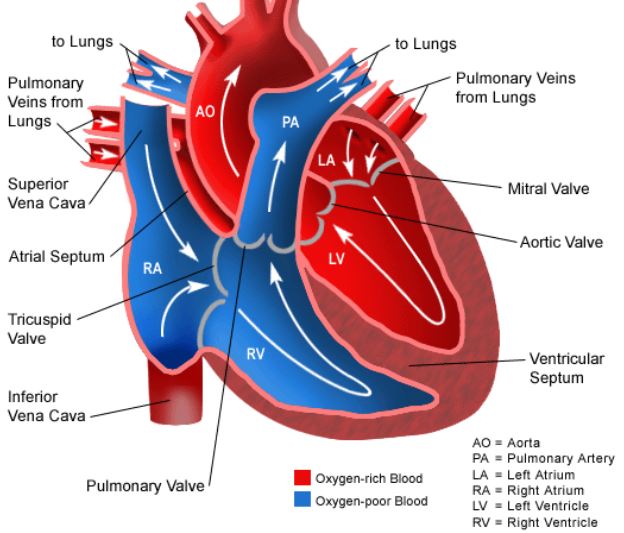
The heart is a muscular organ that functions as a pump to circulate blood throughout the body.
- Four Chambers: Right atrium, right ventricle, left atrium, left ventricle
- Valves: Tricuspid, pulmonary, mitral, aortic
- Layers: Endocardium, myocardium, epicardium
Blood Vessels
A network of vessels that transport blood throughout the body.
- Arteries: Carry oxygenated blood away from the heart (except pulmonary artery)
- Arterioles: Small arteries that regulate blood flow
- Capillaries: Thin-walled vessels for exchange of substances
- Venules: Small veins that collect blood from capillaries
- Veins: Carry deoxygenated blood toward the heart (except pulmonary veins)
Blood
The fluid medium that transports substances throughout the body.
- Plasma: Liquid component (55% of blood volume)
- Red Blood Cells (Erythrocytes): Transport oxygen
- White Blood Cells (Leukocytes): Immune defense
- Platelets (Thrombocytes): Blood clotting
Cardiovascular Physiology
Cardiac Cycle
The sequence of events that occurs during one complete heartbeat.
- Systole: Contraction phase
- Diastole: Relaxation phase
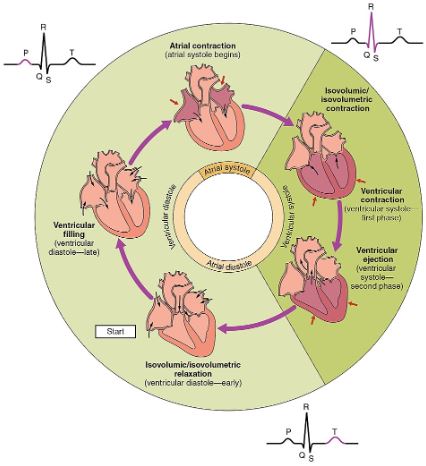
Figure: Cardiac Cycle
Cardiac Output (CO) = Heart Rate (HR) × Stroke Volume (SV)
Where Stroke Volume is the amount of blood pumped by the left ventricle in one contraction.
Blood Pressure
The force exerted by circulating blood on the walls of blood vessels.
- Systolic Pressure: Maximum pressure during ventricular contraction
- Diastolic Pressure: Minimum pressure during ventricular relaxation
Electrical Conduction System
Specialized cardiac cells that generate and conduct electrical impulses to coordinate heart contractions.
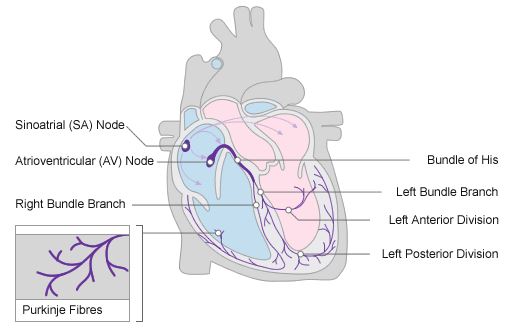
- Sinoatrial (SA) node → Atrioventricular (AV) node → Bundle of His → Purkinje fibers
Hemodynamics
The study of blood flow and the forces involved in circulation.
Poiseuille's Law: Describes the flow of fluid through a cylindrical tube
Where Q is flow rate, ΔP is pressure difference, r is radius, η is viscosity, and L is length.
Key Hemodynamic Parameters
- Flow Rate (Q): Volume of blood flowing per unit time
- Velocity (v): Speed of blood flow
- Resistance (R): Opposition to blood flow
- Compliance (C): Ability of vessels to expand
BME Application: Understanding hemodynamics is crucial for designing cardiovascular devices like stents, artificial heart valves, and vascular grafts that must accommodate physiological blood flow patterns.
Cardiovascular Measurements and Diagnostics
Electrocardiography (ECG/EKG)
Recording of the electrical activity of the heart.
- P wave: Atrial depolarization
- QRS complex: Ventricular depolarization
- T wave: Ventricular repolarization
Echocardiography
Ultrasound imaging of the heart to assess structure and function.
Blood Pressure Measurement
Direct (invasive) and indirect (non-invasive) methods.
Cardiac Catheterization
Invasive procedure to diagnose and treat cardiovascular conditions.
BME Application: Biomedical engineers develop and improve diagnostic equipment like ECG machines, blood pressure monitors, and imaging systems to enhance accuracy, portability, and accessibility.
Cardiovascular Pathophysiology
Atherosclerosis
Build-up of plaque in arterial walls, leading to reduced blood flow.
Hypertension
Chronic elevation of blood pressure.
Heart Failure
Inability of the heart to pump sufficient blood to meet body's needs.
Arrhythmias
Abnormal heart rhythms resulting from conduction system disorders.
BME Application: Understanding pathophysiology drives the development of treatments like drug-eluting stents for atherosclerosis, pacemakers for arrhythmias, and ventricular assist devices for heart failure.
Biomedical Engineering Applications
Cardiovascular Devices
- Pacemakers: Regulate heart rhythm
- Defibrillators: Restore normal rhythm
- Stents: Keep arteries open
- Heart Valves: Replace damaged valves
- Ventricular Assist Devices (VADs): Support heart function
- Artificial Hearts: Replace failing hearts
Diagnostic Technologies
- ECG monitors
- Blood pressure sensors
- Pulse oximeters
- Imaging systems (MRI, CT, ultrasound)
Tissue Engineering
Developing biological substitutes to repair or replace damaged cardiovascular tissues.
Self-Assessment Quiz
Additional Resources
Textbooks
- Guyton and Hall Textbook of Medical Physiology
- Cardiovascular Physiology by Mohrman and Heller
- Biomechanics: Circulation by Fung
Online Resources
- Khan Academy - Circulatory System
- American Heart Association
- NIH National Heart, Lung, and Blood Institute
Professional Organizations
- Biomedical Engineering Society (BMES)
- American Institute for Medical and Biological Engineering (AIMBE)
- IEEE Engineering in Medicine and Biology Society (EMBS)